> For the complete documentation index, see [llms.txt](https://guides.smolcompute.xyz/llms.txt). Markdown versions of documentation pages are available by appending `.md` to page URLs; this page is available as [Markdown](https://guides.smolcompute.xyz/1/tracker/watchlists.md).
# Watchlists
The ⭐️ **Watchlists** tab allows you to create multiple watchlists.
The watchlists are housed in table-blocks that you can duplicate and reorder easily.
### Creating Watchlists
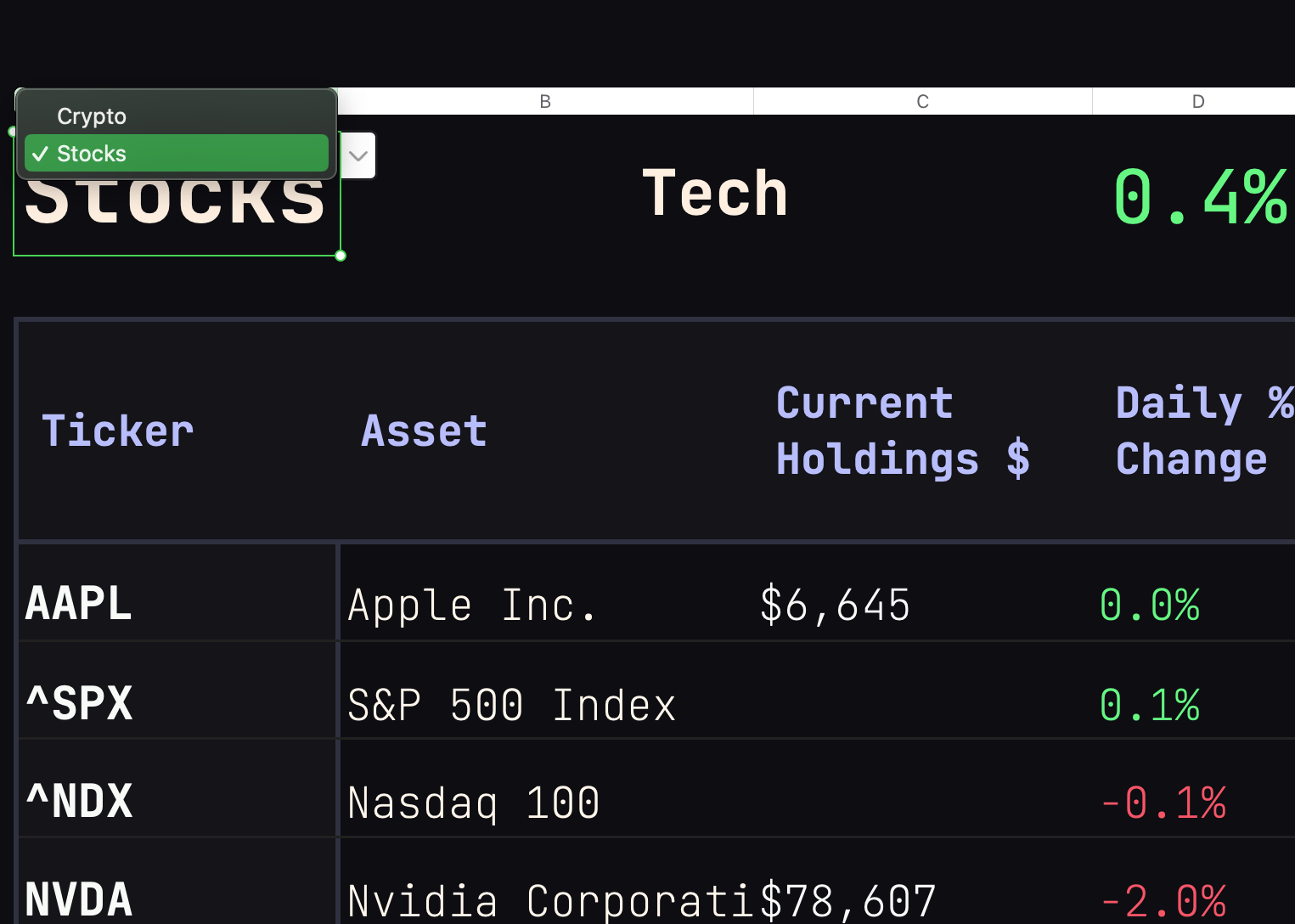
Each table-block is either a *stocks* watchlist or a *crypto* watchlist. You set this in cell A1 of each block.
Setting the Watchlist Type.
After setting the type for a block, enter some tickers in column A. The watchlist will immediately populate with relevant information.
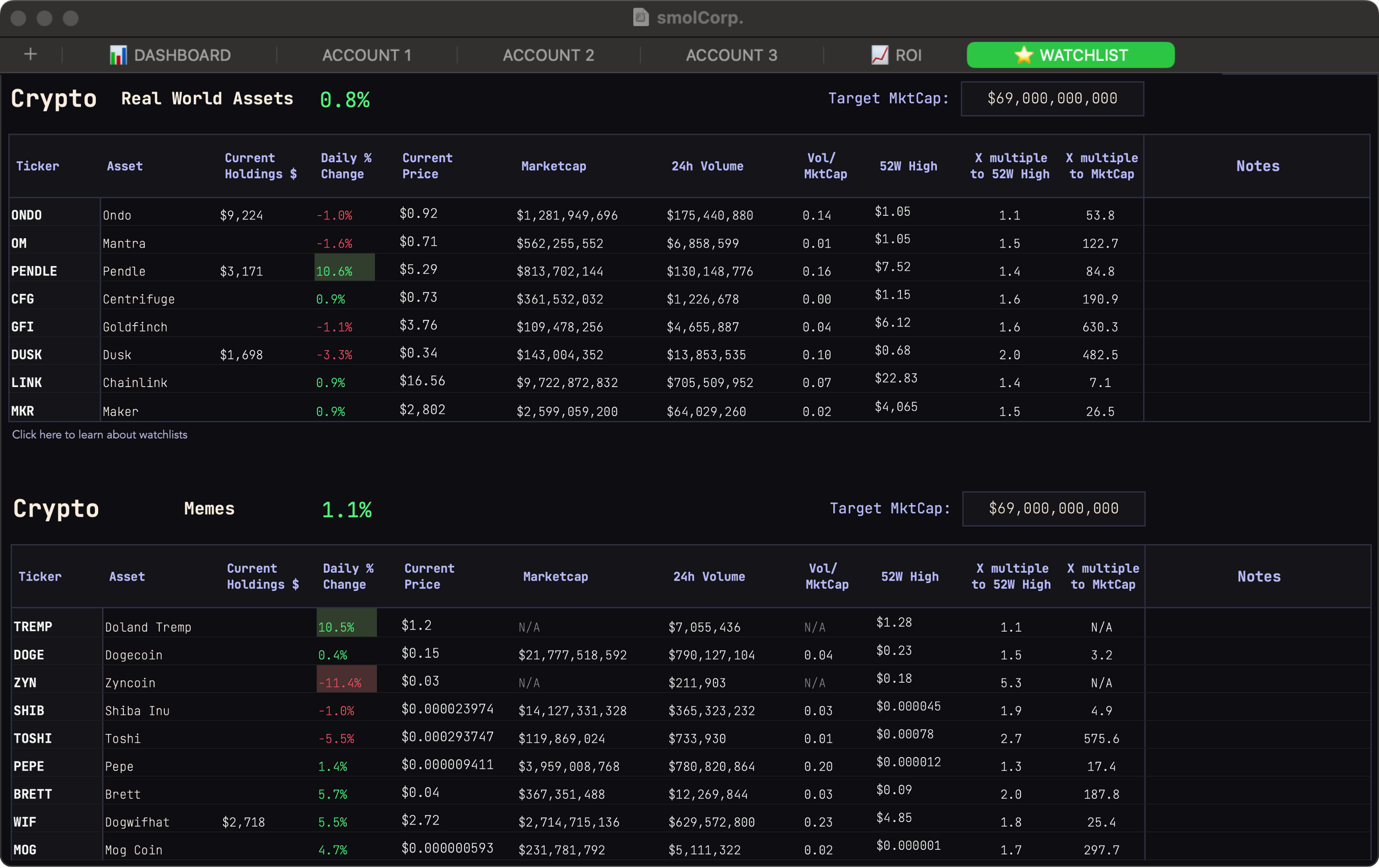
Duplicate the blocks to create as many watchlists as you want. Name your lists in cell B1.
The Watchlists Tab
### Using the Target Market Cap Tool
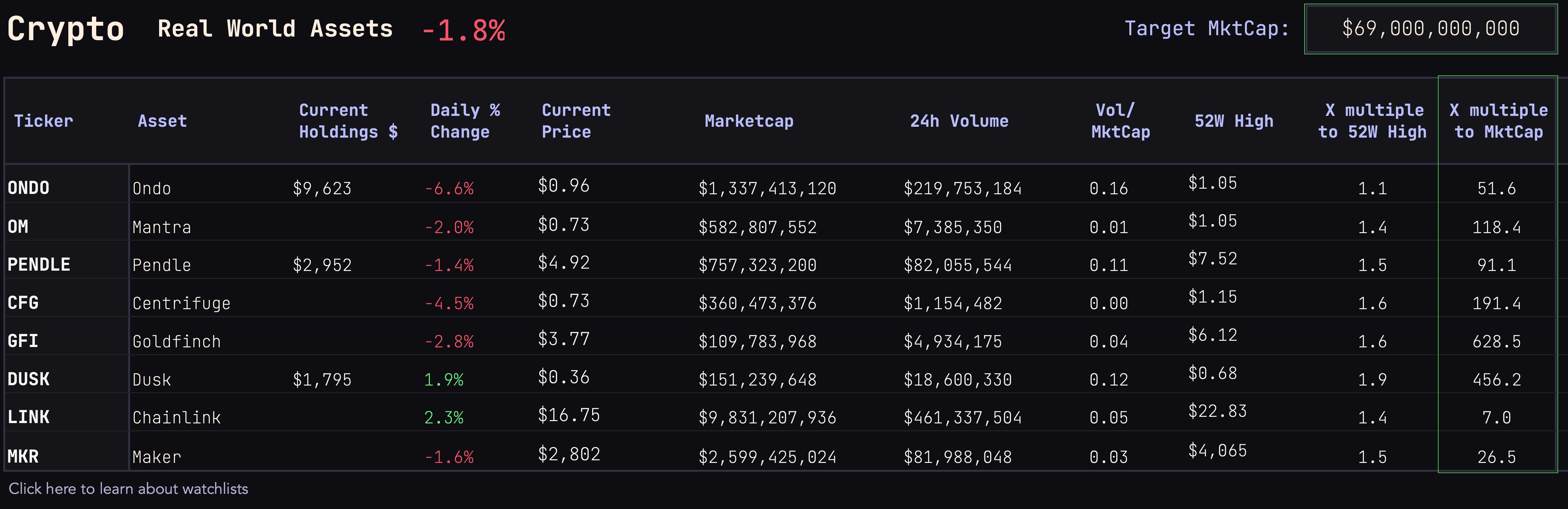
The **Target MktCap Tool** allows you to set a target market cap to see, for each asset in your watchlist, the X multiple in market cap growth that corresponds to this asset reaching the target market cap.
For example:
Say I set the target market cap to $69,000,000,000, roughly the current market cap of DOGE.
Column L will then display the X multiple implied by each asset reaching a market cap of $69,000,000,000.
Since the current market cap of MKR is roughly $2,600,000,000, reaching the target market cap would mean roughly a 26.5 X increase in the price of the MKR token (assuming the circulating supply stays the same).
The Target MktCap Tool
See the included Demo Portfolio to get familiarized with this new section.